
Battle-proven airframes. Swarm-ready.
Built for contested airspace.
The FPX platform family is cost-optimized, AI-enabled, and combat-credible — UAVs that keep flying, keep seeing, and keep talking when GPS is denied and the spectrum turns hostile.
The platform
Four advantages, one airframe.
FPX — battle-proven, built for the fight.
FPX is KYRO's flagship UAV platform: a cost-effective, combat-credible family of aircraft built on battlefield-proven Ukrainian drone technology and AI-enabled capability. The FPX quadcopter leads the line today — affordable to field in numbers, swarm-capable, and engineered to operate where ordinary drones stop working. More FPX variants are on the roadmap as the platform line grows.


Heritage that means something
FPX draws on drone technology forged in the most demanding electronic-warfare environment on earth. Not lab theory — a lineage shaped by real contested operations, brought into a platform we control and build to standard.
Cost-optimized to field at scale
FPX is built to be affordable in numbers, so you can put mass over the objective without putting your budget out of the fight.
A growing platform family
The FPX quadcopter leads today; the line is built to extend to additional airframes and mission roles as the family grows.
AI-enabled, and getting smarter
FPX already leverages AI-enabled capability, and KYRO is deepening it — onboard autonomy, target recognition, and mission planning that cut operator workload and link dependence.
Swarm-ready by design
FPX platforms are built to coordinate, so a handful of aircraft can operate as a single element. See how swarms work →
On a path to standard
We're upgrading FPX to meet U.S. and NATO military requirements, integrating advanced anti-jam and anti-detection (LPI/LPD) performance and GPS-denied operation through the C2 Power Cell.
- Continued investment in autonomy and target recognition
- Smarter, faster mission planning
- Deeper swarm autonomy
- Hardened electronic-warfare resilience
- Conformance to U.S. / NATO military standards
Many aircraft. One element.
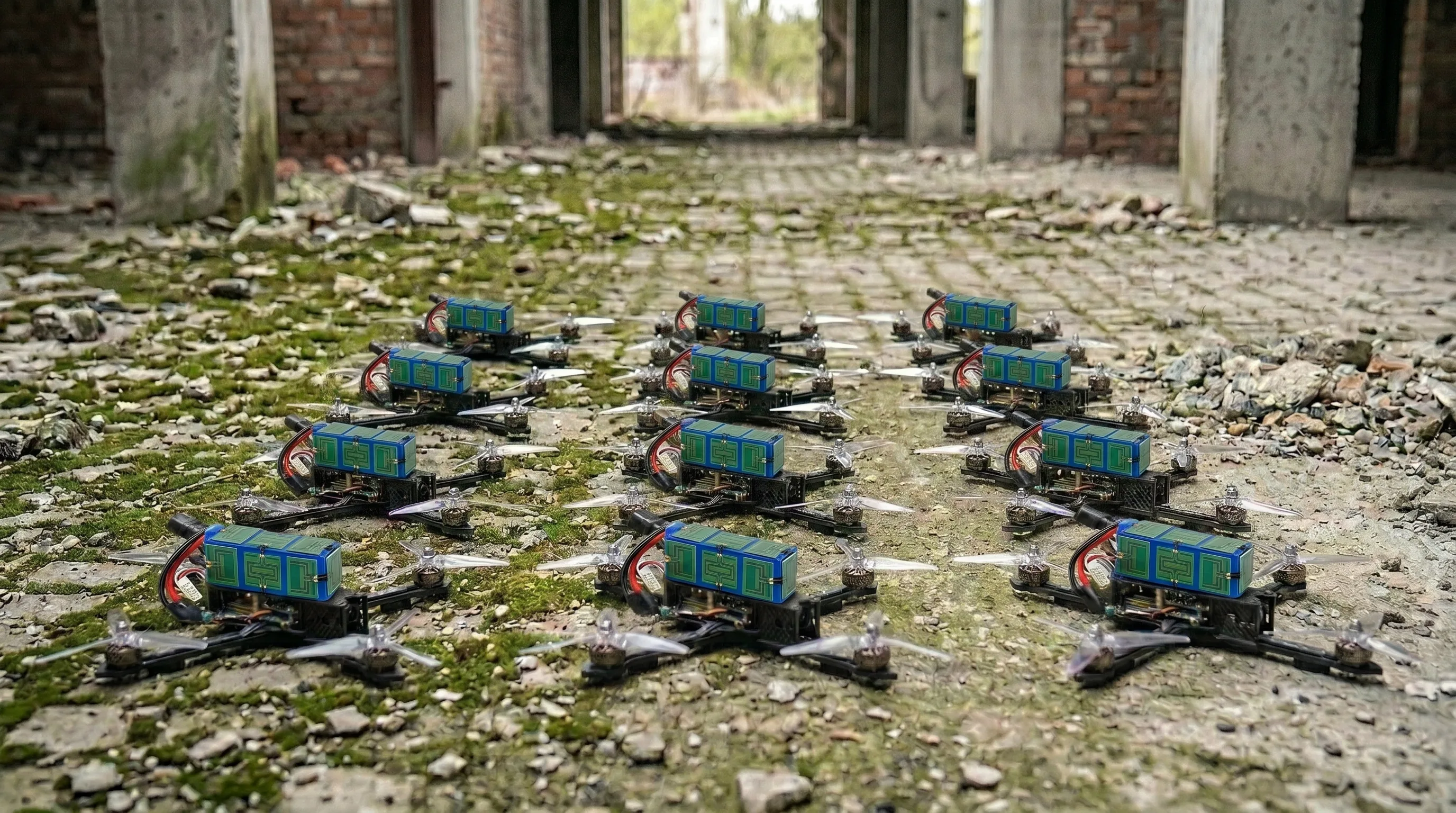
A single drone is a sensor. A swarm is a capability. FPX is built to operate in coordinated numbers — affordable airframes that mass over an area, share what they see, and keep working even as individual aircraft drop out.
Mass at low cost
FPX's cost-optimized airframe is what makes numbers practical. Field enough aircraft to saturate an area without an unaffordable price tag.
Coordinated, not just clustered
Swarming FPX platforms are designed to act as one element — distributing tasks across the group rather than flying as isolated singles.
Resilient by redundancy
When one aircraft is lost or jammed, the element keeps going. No single point of failure to hunt.
Built to grow more autonomous
Deeper swarm autonomy is on the roadmap, reducing the operator load of running many aircraft at once.
AI Insight — the operator does more with less.
FPX is AI-enabled today, and KYRO is investing to deepen it. The goal is simple: move intelligence onto the aircraft so the operator commands the mission instead of flying the drone — and so the platform stays useful even when the link is degraded.
Onboard autonomy
Flight and navigation tasks handled aboard the aircraft, so it keeps doing its job with less moment-to-moment piloting.
Target recognition
AI-assisted recognition to help surface what matters in the sensor feed faster. (In active development.)
Smarter mission planning
Faster planning that turns intent into a flyable mission with less manual work.
Less workload, less link dependence
Intelligence onboard means the operator carries less, and the aircraft needs the link less to stay useful.
Four things FPX brings to the fight.
Battle-proven airframes, intelligence onboard, and a comms link built for contested spectrum add up to a platform that operates farther, survives longer, recovers faster, and shows up in numbers.
01 — Reach
Standoff distance the stock link can't give you. Operate farther from the launch point, closer to the objective.
02 — Survivability
A low-probability signal is a smaller target. Harder to find means harder to jam, spoof, or hunt.
03 — Resilience
When GPS drops and the spectrum gets ugly, the aircraft keeps flying the mission instead of falling out of it.
04 — Mass / Scale
Cost-optimized airframes you can field in numbers — and swarm — so capability scales with the mission, not the budget.
The C2 Power Cell — resilient comms, built in.
What lets FPX keep flying when the spectrum turns hostile is the C2 Power Cell: a high-performance flight battery with a low-signature communications and command-and-control payload built into the cell itself. The radio, the antennas, and the link ride along with the power — so resilient C2 takes up the space you were already giving to a battery, with nothing added to the silhouette.

Most platforms treat comms as a box you bolt on — a payload you trade for endurance, a weak point an adversary can hear. KYRO moves the link into the energy source, upgrading the aircraft's reach, resilience, and survivability in a single drop-in part.
Comms-integrated by design
Power and datalink in a single line-replaceable cell. No separate radio to mount, wire, or account for.
Built for low detection — LPI/LPD
Engineered to keep the link hard to intercept, hard to detect, and hard to geolocate — so the aircraft works without announcing itself.
Long-range capable
Designed to extend operational reach well beyond a stock control link — opening standoff and deep-area missions.
GPS-denied operation
Keeps the aircraft controllable and useful when satellite navigation is degraded, spoofed, or gone.
Drop-in upgrade path
A line-replaceable cell for the FPX platform — resilient comms in the part your crews already handle every sortie, with a roadmap to additional airframes.
When the spectrum turns hostile.
The modern battlefield is loud, jammed, and watched. Control links get cut. GPS gets spoofed. Emissions get hunted. The platforms that win are the ones still flying when that happens — and quiet enough not to be the next target. That's what FPX is built for: battle-proven airframes, swarm numbers, and a comms link designed to keep the aircraft connected, located, and under positive control when the electromagnetic environment is working against it — without lighting up the spectrum.

- Holds the link through jamming and interference
- Stays hard to detect, intercept, and geolocate (LPI/LPD)
- Keeps flying when GPS is degraded or denied
- Extends range for standoff and deep-area work
- Fields and swarms at low cost
RF is in our blood.
KYRO is the unmanned-systems arm of BATS Wireless — a team that has spent its life keeping radio links alive where infrastructure fails and the spectrum fights back. Resilient RF isn't a feature we added to a drone company. It's the foundation the whole thing is built on.
That heritage is why the link lives inside the cell, why low-probability signaling came first, and why "it still works when the network is contested" is the starting point of every KYRO design — not the afterthought.
A BATS Wireless company
Battle-proven UAVs for contested airspace.
The essentials, kept qualitative.
Releasable capability summary. Exact performance figures — range, frequency, power, detection — are program-dependent and screened against export and OPSEC requirements before release.
- Class
- Cost-effective multirole UAV platform (quadcopter leads the line)
- Heritage
- Battlefield-proven Ukrainian drone technology
- Autonomy
- AI-enabled — onboard autonomy, target recognition, mission planning (in active development)
- Swarm
- Swarm-capable; deeper swarm autonomy on roadmap
- EW
- Anti-jam / anti-detection, GPS-denied (via C2 Power Cell)
- Standards
- Being upgraded to U.S. / NATO military requirements
- Function
- High-performance flight battery with integrated comms + C2
- Signature
- LPI / LPD — low probability of intercept & detection
- Range
- Long-range capable (extended standoff; program-dependent)
- Navigation
- GPS-denied capable
- Form factor
- Drop-in cell for the FPX platform
- Integration
- No airframe redesign; adaptable roadmap to additional airframes
See it for yourself.
For program offices, primes, integrators, and allied defense organizations. Tell us your operating environment and we'll arrange a capability briefing and a demonstration of the FPX platform.
Inquiries are reviewed for eligibility. A KYRO representative will follow up to verify and schedule.
Request a briefing